FD vs Home Loan Prepayment: The ₹36,840 Rate Gap Explained
Keeping a 7% FD while paying 8.5% on a home loan loses ₹36,840 a year on ₹10 lakh at the 30% slab. See the maths, the prepayment effect and the risks.
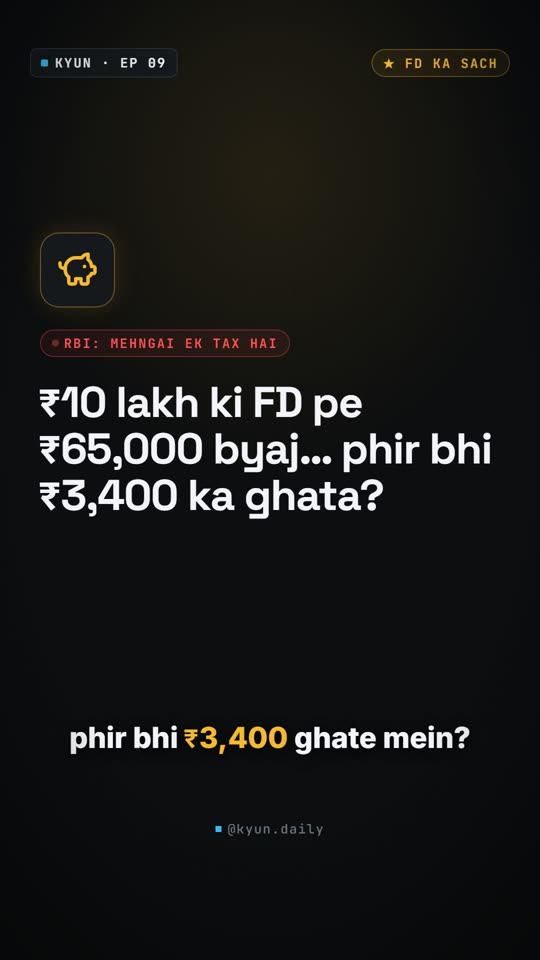
Is it smart to keep ₹10 lakh in a fixed deposit (FD) and use its interest to help pay your home loan EMI? In the example this article works through, the numbers say no. At the 30% tax slab under the new tax regime, a 7% FD leaves you with ₹48,160 a year on ₹10 lakh after tax, while the same ₹10 lakh owed on an 8.5% loan costs ₹85,000 a year. That is a gap of ₹36,840 every year. If that money prepays the loan instead, a ₹30 lakh, 20-year loan closes in about 9.3 years and total interest falls from about ₹32.5 lakh to about ₹9 lakh. Three checks come first, covered below.
Why the gap exists
Two things work against the FD holder. First, FD interest is added to your income and taxed. The calculation behind this post uses the 30% slab plus 4% cess, which is a 31.2% rate, so ₹70,000 of interest loses ₹21,840 to tax. Second, under the new tax regime there is no Section 24(b) deduction for interest on a self-occupied home, so the ₹85,000 you pay on the loan gets no tax relief. You earn 7% that is taxed and pay 8.5% that gets no relief.
| Per year, on ₹10 lakh | Held in an FD at 7% | Owed on a loan at 8.5% |
|---|---|---|
| Interest | ₹70,000 earned | ₹85,000 paid |
| Tax at 31.2% | ₹21,840 | No deduction under the new regime |
| Net amount | ₹48,160 in hand | ₹85,000 cost |
| Effective rate | 4.816% | 8.5% |
The difference is ₹85,000 minus ₹48,160, which is ₹36,840 a year, or 3.684 percentage points. At a 31.2% tax rate, an FD would need to pay about 12.35% before tax to leave you 8.5% after tax (our own arithmetic: 8.5 ÷ 0.688).
Tax is not the only reason. Even if FD interest were tax-free, 7% would trail 8.5% by 1.5 points, which is ₹15,000 a year on ₹10 lakh. So ₹36,840 belongs to the 30% slab and these two rates. A lower slab narrows the gap but, at these rates, does not reverse it.
Both rates are assumptions. Floating loan rates and FD rates change over time, so replace 7% and 8.5% with your own numbers before drawing any conclusion.
What prepaying does to a ₹30 lakh loan
Take a ₹30 lakh loan at 8.5% over 20 years (240 months). The EMI is ₹26,035 and the total interest over the full term is about ₹32.48 lakh. Now suppose you prepay ₹10 lakh at the very start and keep paying the same EMI of ₹26,035. The remaining ₹20 lakh closes in 112 months, which is about 9.3 years, with total interest of about ₹8.98 lakh.
| Item | No prepayment | ₹10 lakh prepaid at the start |
|---|---|---|
| Loan outstanding | ₹30 lakh | ₹20 lakh |
| EMI | ₹26,035 | ₹26,035 |
| Months to close | 240 (20 years) | 112 (about 9.3 years) |
| Total interest | about ₹32.48 lakh | about ₹8.98 lakh |
| Interest avoided | none | about ₹23.5 lakh |
Why does one part payment change so much? Early in a loan, most of each EMI is interest. In month one on ₹30 lakh, interest is about ₹21,250 (₹30 lakh × 8.5% ÷ 12), so only about ₹4,785 of the EMI reduces the principal. After the prepayment, month-one interest on ₹20 lakh is about ₹14,167, so about ₹11,868 goes to principal. The balance falls faster, which is also why prepaying early saves more than prepaying late. These month-one figures are our own arithmetic from the same rate and EMI.
One honest caveat: the ₹23.5 lakh is interest avoided on the loan side only. It does not subtract what the ₹10 lakh would have earned in an FD meanwhile, which at this post's assumptions is ₹48,160 a year after tax. It also assumes the rate stays at 8.5%. So the real gain is smaller, by an amount that depends on how long you would have kept the FD and at what rate.
Who this affects
The example fits a specific person: someone with a floating-rate home loan, a sizeable FD or idle savings, and income in the 30% slab under the new regime. For them, each rupee in the FD earns less after tax than it costs in loan interest.
It fits less well in these cases:
- You are on the old tax regime, where interest on a self-occupied home may be deductible (see check 3).
- Your FD is your emergency fund or is earmarked for a goal in the next few years.
- Your loan rate is fixed, or your agreement carries a prepayment charge.
Three checks before you prepay
1. Keep an emergency fund apart
The reel's rule is to keep six months of expenses aside before prepaying anything, because money prepaid into a loan cannot be taken back out. An FD can usually be broken early in an emergency, though terms differ. If you drain it to cut the loan and then need cash, you may end up borrowing at a higher rate. Whether six months suits you depends on how stable your income is.
2. Check for prepayment charges
The reel says floating-rate home loans carry no prepayment fee, citing an RBI rule that bars foreclosure and prepayment charges on floating-rate term loans to individuals. Treat that as a starting point, not a guarantee. We could not confirm the exact wording on the RBI page linked in our sources, so read the current RBI text and your loan agreement, and ask your lender in writing whether any charge applies, especially for a fixed-rate loan. Also ask how a part payment is applied: the example keeps the EMI unchanged and shortens the tenure, and your lender's default may differ.
3. Do the old-regime maths separately
Under the new regime, interest on a self-occupied home gets no Section 24(b) deduction, which is why the table above shows none. Under the old regime, the page we cite says the deduction for a self-occupied property goes up to ₹2 lakh. That relief means your real cost of the loan is below 8.5%, so the gap is smaller than ₹36,840. By how much depends on your own tax position, which we have not worked out here. Prepaying also lowers the interest you pay, and so the interest you can claim. The same page says interest on a let-out property stays deductible under both regimes, up to rental income, so a rented-out home needs its own calculation.
Common mistakes
- Comparing 7% with 8.5% and stopping there. The pre-tax gap is 1.5 points. After tax in the 30% slab it is 3.684 points.
- Treating ₹36,840 as a number for everyone. It belongs to a ₹10 lakh deposit at 7%, a loan at 8.5%, the 30% slab and the new regime. Change any one and the figure changes.
- Calling ₹23.5 lakh a profit. It is gross interest avoided and ignores the FD earnings you give up.
- Assuming the lender will shorten the tenure on its own. Confirm in writing how the part payment is applied.
What you can do
- List your FDs and mark which are the emergency fund and which are meant for goals in the next few years. Only the rest is a candidate for prepayment.
- Pull your loan statement and note the outstanding principal, whether the rate is floating or fixed, the current rate, the EMI and the remaining months.
- Work out your own after-tax FD rate: FD rate × (1 − your tax rate). In the 31.2% case, 7% × 0.688 = 4.816%. Compare that with your loan rate.
- Ask the lender in writing about prepayment charges and whether a part payment shortens the tenure or lowers the EMI.
- If the numbers favour it, prepay an amount that leaves your emergency fund intact.
Key takeaways
- At the 30% slab under the new regime, ₹10 lakh in a 7% FD nets ₹48,160 a year, while ₹10 lakh owed at 8.5% costs ₹85,000. The gap is ₹36,840 a year.
- Even with no tax at all, 7% would trail 8.5%. Tax widens the gap.
- Prepaying ₹10 lakh on a ₹30 lakh, 20-year, 8.5% loan at the same ₹26,035 EMI closes it in 112 months and cuts interest from about ₹32.48 lakh to about ₹8.98 lakh.
- The ₹23.5 lakh is gross interest avoided, not profit, because it ignores what the FD would have earned.
- Keep an emergency fund, confirm prepayment charges in writing, and redo the maths if you are on the old regime.
FAQ
Does the ₹36,840 yearly gap apply to everyone?
No. It comes from a ₹10 lakh FD at 7%, a loan at 8.5%, the 30% slab with 4% cess (31.2%) and the new tax regime. Change any of these and the number changes.
Will my bank charge a fee if I prepay my home loan?
The reel cites an RBI rule that bars foreclosure and prepayment charges on floating-rate term loans to individuals. Confirm the current RBI wording and your loan agreement, and ask your lender in writing, especially for fixed-rate loans.
How much emergency fund should I keep before prepaying?
The reel suggests setting aside six months of expenses separately. The right size for you depends on how stable your income and expenses are.
Does the old tax regime change the answer?
Yes. The cited page says the old regime allows a Section 24(b) deduction up to ₹2 lakh on a self-occupied home, while the new regime allows none. That lowers the real cost of the loan, so the gap will be smaller than ₹36,840.
Sources
- Own calculation: EMI ₹30L 8.5% 240 months = ₹26,035, total interest ₹32.48L; ₹20L at same EMI closes in 112 months, interest ₹8.98L; FD ₹70,000 × 31.2% (30% + 4% cess) = ₹21,840 tax
- RBI: no foreclosure / prepayment charges on floating rate term loans to individuals — rbi.org.in
- New tax regime: no Section 24(b) deduction for self-occupied home loan interest — cleartax.in
Kyun explainers are for education only, not financial, tax or legal advice. Rules and rates change; check the sources above or a qualified advisor before you act.